Thursday, September 22, 2011

Ian has


I had my phone off because I was in a meeting. When I turned it back on, it buzzed letting me know what texts were waiting. I scrolled down the list until I saw the title of one that made me catch my breath.

Ian has

I didn't want to open the text and finish the sentence. I knew there had been an MRI to check on the reason for back pain. I knew there had been two previous devastating MRI results, one six years, and another three years ago. I did not want to see the reality that this fine young man was facing his enemy for the third time in his short life. I didn't want to finish the sentence "Ian has ______" as if not opening that text would somehow keep it from being true.

But, it is true. Ian has cancer, again. This is the third time he has heard this news, the third time he has had to rearrange his life, the third time he has had to face treatment and the uncertainty it brings.

Yes, Ian has cancer, but he has so much more. We can finish that sentence with better words that are just as true.

Ian has peace.

Peace I leave with you: My peace I give you. I do not give to you as the world gives. Do not let your hearts be troubled and do not be afraid. John 14:27

Last Sunday, Ian stood up in front of the congregation and thanked us for our prayers. He took time to reassure us that he had peace about the diagnosis and treatment. This young man, barely a teenager, has the courage and presence of mind to share his peace with those of us who pray and grieve over him. God has blessed him with a peace we cannot even imagine and in that peace we see evidence of the gift of his faith.

Ian has prayers.

Therefore, since we are surrounded by such a great cloud of witnesses, let us throw off everything that hinders and the sin that so easily entangles. And let us run with perseverance the race marked out for us, fixing our eyes on Jesus, the pioneer and perfecter of faith. For the joy set before him he endured the cross, scorning its shame, and sat down at the right hand of the throne of God. Consider him who endured such opposition from sinners, so that you will not grow weary and lose heart. Hebrews 12:1-3


Ian has a huge cloud of witnesses surrounding him in this race. We pray for him, cry over him, cheer him on, and stand ready to help in any other way that is needed. Because of his premature birth, Ian has literally grown up in the midst of this cloud of people who love him and pray for him. He feels this every day in a tangible way. His courage in this race gives us evidence of the gift of our faith.

Ian has the promise of eternal life.

For God so loved the world that he gave his one and only Son, that whoever believes in him shall not perish but have eternal life. John 3:16


In the light of Ian's challenge this verse takes on a whole new significance. He will not perish; he has eternal life. We pray the next 80 years or so of that eternal life are spent here on earth, but we know that he has eternal life, none-the-less.


Abba, Father, Please, send your hand of healing to your child, Ian, even as You bless him with peace, strength and faith. Amen, amen, amen.

Wednesday, August 17, 2011

Dependence day


The classes I am taking this semester are up on my on-line Blackboard page. This means I can take an early peek at the syllabus, assignments and textbooks.

Excuse me while I breathe in this paper bag for a minute . . . . . easy. . . . .calm down . . . .

I have already decided to drop one of the three classes I registered for because the first two have an enormous workload: 4 class discussions to lead, 5 papers, 73 readings and one large project. All I know about the third class is that it has 3 required textbooks and about 10 recommended. That is more than enough reason to save that class for another semester.

This time in the semester is not a good time for me. I know too much about what will be expected of me, but I have little reminder of the good parts of going to school. By next week I will still feel overwhelmed, but I will also have touched base with several people with whom I have developed a strong friendship. In seeing them, again, God will remind me that He has a plan on how to get me through this semester.

In the reading I did this summer, I came across an interesting idea. Much of Developmental Psychology of the last 100 years, or so, has centered on the idea that when we are born we bond, or attach, to our parents and spend the rest of our childhood going from complete dependence to independence. The point being made in the book was that the field is starting to realize the reverse may also be true. In other words, we are born, bond with our parents and that is the first step in learning how to work with, and depend on, others. In fact, the more we study learning, the more we realize that social skills, such as empathy, are a key component to good learning.

Becoming independent is not a theme in scripture; at least not a theme with a good ending. If we work toward independence we work ourselves away from God. Here is a good example:

For I solemnly warned your fathers when I brought them up out of the land of Egypt, warning them persistently, even to this day, saying, Obey my voice. Yet they did not obey or incline their ear, but everyone walked in the stubbornness of his evil heart. Therefore I brought upon them all the words of this covenant, which I commanded them to do, but they did not." Jeremiah 11: 7-8 (ESV)

In our sin we want to be independent, but the effect is similar to a two-year-old insisting "me do it." We simply cannot do anything on our own. We are completely dependent on God.

So Jesus said to the Jews who had believed in him, "If you abide in my word, you are truly my disciples, and you will know the truth, and the truth will set you free." They answered him, "We are offspring of Abraham and have never been enslaved to anyone. How is it that you say, 'You will become free'?"

Jesus answered them, "Truly, truly, I say to you, everyone who commits sin is a slave to sin. The slave does not remain in the house forever; the son remains forever. So if the Son sets you free, you will be free indeed. John 8: 31-36 (ESV)

I am looking at this verse in a new way. I need to be enslaved (dependent on) to God in order to experience freedom (independence). So for now, I will go to God in prayer, begin my reading assignments, and meet with two good UNL friends for a picnic lunch, tomorrow. God's promise to love and care for me will filter into my brain and heart as I read and pray over His word.

Remember your word to your servant,
in which you have made me hope.
This is my comfort in my affliction,
that your promise gives me life. Psalm 119:49-50

Thank you, God, for new adventures (even scary ones), thank you for friends and thank you for complete and utter dependence on You.

Thursday, August 4, 2011

The power and pattern of hope


Hope is an interesting concept. In the secular world it is a fingers-crossed kind of emotion where you make a wish and hope it comes true. In the education world hope can often be a glass-half-full optimism; if you have a strong sense of self-efficacy you will most likely succeed at what you try. In the Bible hope is something all-together different. It is not fingers-crossed or glass-half-full, it is a grave-completely-empty assurance of God's love for us. We have hope that heaven awaits our arrival because we have assurance that our entrance into heaven has already been earned for us through Christ's death and resurrection.

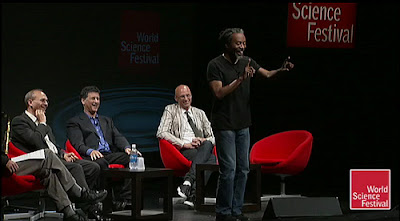
Here is a World Science Federation tape of Bobby McFerrin. In this activity where Bobby turns an entire audience of science nerds into a musical instrument where they can sing one line while he sings another is a fascinating thing to see. At the end of the clip Bobby gives us a reason why this works. Apparently the pentatonic scale is hardwired into our brain. When he proceeds to teach the audience how to sing this way he has confidence that they can access this information and put it to use in this situation.

But this is the covenant that I will make with the house of Israel after those days, declares the LORD: I will put my law within them, and I will write it on their hearts. And I will be their God, and they shall be my people. Jeremiah 31:33 (ESV)

and hope does not put us to shame, because God's love has been poured into our hearts through the Holy Spirit who has been given to us. Romans 5:5 (ESV)

We are hardwired to know God. He has placed His law into our hearts and through the miracle of baptism has also placed His love and Spirit. Because of the faith He gives us, we have the possibility of knowing and feeling His love and care. We have the kind of hope that is an assurance, that is definite, that is as certain as God himself.

But there is more . . .

At the beginning of the clip Bobby talks about expectations. Bobby does not have to use any words to teach the audience the game. He uses his actions and their understanding of the pentatonic scale to teach them how to anticipate or expect the next note. The audience can instantly perform because of the many years of exposure to the scale. The audience is not lagging behind their teacher, but, is in sync with his teaching.

God has placed His word into our hearts but He has also demonstrated His love for us over and over, again. He has set up a pattern of expectations just as Bobby McFerrin set up an imaginary xylophone. God's pattern is complete and completely consistent. Our hope is an assurance and an expectation.

May you be led by God's teaching and rest in the assurance of His hope. He has great plans for you and has written those plans in your heart.

The LORD looks down from heaven; he sees all the children of man; from where he sits enthroned he looks out on all the inhabitants of the earth, he who fashions the hearts of them all and observes all their deeds. The king is not saved by his great army; a warrior is not delivered by his great strength. The war horse is a false hope for salvation, and by its great might it cannot rescue. Behold, the eye of the LORD is on those who fear him, on those who hope in his steadfast love Psalm 33: 13-18 (ESV)


Monday, July 25, 2011

Trust


In Bible class, this past Sunday, we talked about how humans develop trust. This goes back to our first few months of life outside the womb and marks the establishment of attachment. We saw a clip of Dr. Edward Tronick's "still face experiment." In this clip a baby and mother engage in typical communication until the mother is instructed to make her face still; to not react to the baby in any way. At this point we study the baby's reaction. She tries everything she knows to get a response from her mother and when nothing works, distress settles in. At about the time I can't stand it anymore, the mother relents and responds to the baby.

This is the typical reaction of babies with a healthy attachment to their parents. These babies have developed patterns of behavior based on the understanding that a parent will react. This is the first thing that is learned in order for a baby to develop socially, emotionally and in language. A baby without a healthy attachment would respond very differently to a still-face mother. These babies have not developed a trust that someone will respond. This creates a scar that prevents most other healthy learning.

Our discussion topic, surrounding this clip, was about trust. When God teaches us to trust we are able to engage in a relationship with Him. As with the mother and child, God does the work in this relationship. He is the one who engages, teaches and responds. Furthermore, He does so perfectly, knowing exactly what we need and when we need it. We are welcome to cry out to Him, however, He has already anticipated both our pain and our needs.

Likewise the Spirit helps us in our weakness. For we do not know what to pray for as we ought, but the Spirit himself intercedes for us with groanings too deep for words. Romans 8:26 (ESV)

We are babies, buckled into a car seat facing our Heavenly Father. We cry, we squirm, we try to draw God's attention; all the time He looks at us in love and understanding. Trust is knowing that God has a plan for our life. Trust is knowing that God can bring good out of anything. Trust is knowing that He will provide what we need, as we need it. Trust is knowing that God has already accomplished all we need or could ever want.

And know this: God never looks at us with a still face.

So that Christ may dwell in your hearts through faith—that you, being rooted and grounded in love, may have strength to comprehend with all the saints what is the breadth and length and height and depth, and to know the love of Christ that surpasses knowledge, that you may be filled with all the fullness of God. Ephesians 3: 17-19 (ESV)

Continue your day with the peace-filled knowledge that God blesses you with trust and always looks at you with love, mercy and peace. You are His precious child.

Wednesday, July 13, 2011

Fixed or Growth?


The last time “This is Your Brain on God” met we discussed Carol Dweck’s theory on fixed vs. growth mindset. This researcher learned that people fall into one of these two categories, depending on whether or not he/she believes his intelligence and behavior are set in stone or can grow and change. Here is a clip on mindset that explains the basic idea.

While very few people would SAY they can’t grow, change or learn, apparently about half of the population acts as if this was true. This means there are a lot of people running around afraid of making a mistake, or trying something new because it will mark them as less than competent. They want to stay safe at their level of competence.

It also means that there are a bunch of people running around who eagerly seek challenges and know they can learn from mistakes. They are not satisfied with their level of competence.

I suspect that growth mindset people make far more mistakes but that fixed mindset people are more likely to sabotage their growth. We human beings sure are messed up in our sin, aren’t we?

So as Christians, living as sinners in a sinful world, what mindset works best for us? Hmmmm, stay away from sin, or grow? I think the real question is which one is possible?

Behold, I was brought forth in iniquity, and in sin did my mother conceive me. Psalm 51:5

We can’t stop ourselves from sinning. We have been sinners from the beginning of our lives and will continue to make mistakes until we die. Trying to prevent ourselves from mistakes is a hopeless task. Trying to follow the law only convicts us of our sin and convinces us of our need for a savior.

For the wages of sin is death, but the free gift of God is eternal life in Christ Jesus our Lord. Romans 6:23

Yet, this whole idea of growing and learning is not without its problems. We can’t improve ourselves anymore than we can stay away from sin.

We have all become like one who is unclean, and all our righteous deeds are like a polluted garment. Isaiah 64:6a

Sounds impossible, and as always, the answer has to be found in a loving Father, the redemptive act of His Son and the work of His Spirit.

Behold, the eye of the LORD is on those who fear him, on those who hope in his steadfast love. Psalm 33:18

We cannot save ourselves by following the law. God saw this and sent Jesus to accomplish justification for us. Through the living of one perfect life, through death and resurrection, we are made righteous in His eyes.

But God did not stop with justification. He continues with sanctification. He sets us apart and works faith in our hearts through the word and sacraments. He changes us.

For it is God who works in you, both to will and to work for his good pleasure. Philippians 2:13

For God has not called us for impurity, but in holiness. I Thessalonians 4:7

And so, from the day we heard, we have not ceased to pray for you, asking that you may be filled with the knowledge of his will in all spiritual wisdom and understanding, so as to walk in a manner worthy of the Lord, fully pleasing to him, bearing fruit in every good work and increasing in the knowledge of God. Colossians 5:9-10

I suspect that we are happiest when we are somewhere in-between fixed and growth mindsets. We are fixed mindset in that we know we are sinners and cannot change that truth. We have a growth mindset in that we know that through the work of God we can grow and bear fruit.

Rejoice that this is true: the burden for our salvation is not ours; the blessings of living a sanctified life can be known to us through word and sacrament.

Thursday, June 16, 2011

Locus of Control


We started last Sunday’s Bible study with this Bob Newhart clip. Or rather, I summarized the clip as we were having internet difficulties. In the clip a woman complains to Bob of her many phobias. What is his advice? He simply tells her to “Stop it!” On one level, this advice seems to make sense, yet we know it can’t work otherwise we could all solve our problems by just stopping.
We could just stop worrying. We could just stop whining. We could just stop self-medicating. We could just stop sinning. Then life would be just great.
We can’t just stop it because even though we think we are in control; we are not.
The psychology concept we looked at is called locus of control. In this theory some people have an external locus which means they believe that their lives are out of their control. They think things are controlled by fate. While these folks tend not to worry or fret, they also see little point in planning or working on change.
The second group has internal locus of control and works from the idea that they can control what happens by working hard. They believe that what happens in their life is controlled by their own actions. While these folks tend to be successful in life, they also have a habit of blaming themselves for things that are not under their control.
I recently heard a scientist say that plants don’t have brains because they can’t move. They have complete external locus of control because there is nothing they can do about their situation, anyway. Animals and humans can move, so we need brains to enable us to make decisions.
The question we discussed was whether or not Christians are internal or external when it comes to control. The answer is not an easy one.
Christians are considered external because we believe that God controls what happens in our life. However, we behave as internal people because we work hard and make plans to change.
I like to think that we are neither external nor internal; we are eternal.
God gave us His law and wrote it in our hearts. We are conceived in sin and proceed through our lives breaking that law on a continuous basis. God sent His Son to live a perfect life and to die and rise again. In this one event we are saved from what we deserve. The control of our salvation is with God and God alone.
But God does not leave it at that. He wants blessings for us in our present life as well as eternal life with Him. He sends His spirit, and through the act of sanctification, works His good in us. We have freedom of will, we have choice, and we can work on things. Anything good that happens in our life is due to the work and blessing of God.
But we have this treasure in jars of clay to show that this all-surpassing power is from God and not from us. We are hard pressed on every side, but not crushed; perplexed, but not in despair; persecuted, but not abandoned; struck down, but not destroyed. 2 Corinthians 4: 7-9 NIV
We try to take control of our life and we create havoc. No wonder we are crushed, perplexed and in despair. God creates a treasure in us and molds us into jars suitable for His work.

Thursday, June 9, 2011

The power of conformity


This past Sunday I had the privilege of starting a new Bible study at our church. It is called "This is Your Brain on God." It is my goal, for each week, to examine psychology theory about humans through the lens of Law and Gospel.

The first lesson was on the power of conformity. We began with this vintage Candid Camera clip. It is a short and hilarious clip of Candid Camera people standing the wrong way in an elevator. In each clip the unsuspecting participant turns the wrong way, too. It is funny because we see ourselves in the clip. We know that we often follow the crowd, even if it is going in the wrong direction.

Well, God made us this way, so He must have done it for a reason. Of course, as sinners we always distort God's perfect plan.

A wise friend in the class pointed out that we have three ways to conform; to the world, to God's Will, or to our own idea of what is right.

Experiments done around 50 years ago by Solomon Asch help us to understand several things about conforming:

  1. If there are at least three people doing the same thing, we are highly likely to follow them.
  2. Some people actually convince themselves that they are wrong when they follow the crowd.
  3. Some people know the crowd is wrong but follow anyway because they don't want to "make waves."
  4. We are less likely to follow the crowd if we have at least one person who agrees with us.


I appeal to you therefore, brothers, by the mercies of God, to present your bodies as a living sacrifice, holy and acceptable to God, which is your spiritual worship. Do not be conformed to this world, but be transformed by the renewal of your mind, that by testing you may discern what is the will of God, what is good and acceptable and perfect. Romans 12: 11-2 (ESV)


In this verse we see part of God's plan for creating us as conformers. We are expected to conform to the will of God. He gave us the ability to do this. However, we miserably fail at that expectation and instead conform to the world. This gets us into big trouble. We align ourselves with people who encourage us to deny our faith. We follow a group that points us away from God and toward sin.

In this verse we are expected to present our bodies as a living sacrifice. We are not to face the wrong way in an elevator, but to face the opposite direction of the world. Because of the sacrifice of God's Son, we become an acceptable sacrifice. Because of the work of the Spirit we are transformed toward what is good and acceptable and perfect. We face the right direction because He turns us toward Himself. We no longer suffer from the distortion of judgment or the fear of being different. In Christ we can give glory for the difference of being God's child.

Remember the last in the list of what we know about conforming: we are less likely to follow the crowd when we have at least one person facing the crowd with us. Fellowship with believers is a gift of God, also.

I encourage you to be in the Word; to attend church and participate in the sacraments. These are things that cause our faith to grow. I also encourage you to engage in fellowship with believers. Indulge in that particular need to conform! Stand with your believers in worship, study and service.

When that elevator door opens you will be ready to go and serve.

Abba, Father, Amen.