Tuesday, June 19, 2012
Ian Alexander Loewe
Monday, June 4, 2012
The still small voice
God said "no" and gave him something to eat.
God sent him to a mountain. Mountains put you in a vulnerable position and Elijah didn't even have a broom tree for protection. Standing on the mountain we can imagine that Elijah saw the enormity of God's power as he contemplated God's creation. Then as he felt the power of the wind, earthquake and fire, Elijah was viscerally reminded of God's omnipotence.
It is interesting to note that Elijah does not retreat to the cave until he hears God's voice in the sound of a low whisper. His retreat is not out of terror, but out of fear. Elijah did not fear for his earthly life; he feared for his spiritual life.
God's word has a way of killing us; it seeks to kill the old Adam in us. As strong as his faith was, Elijah's old Adam was a lack of faith. He knew there was nothing more that he could do to protect himself and his fellow children of God from the evil that surrounded them. He simply forgot that God did have that power and a plan.
That small still voice was sent to remind Elijah of an unimaginable power.
The graduate program that I am in has stretched me beyond my abilities and I have reached a point of constant reminder that I do not have the gifts to complete this journey. I am not smart enough. I can't do the numbers. I can't do the words. I want to quit while I still have some confidence left.
God says "no" and feeds me through His word and sacraments.
He says that now that I know I am not able to do this on my own I am ready.
What is the "impossible" you face today? Is your faith stretched to its limits? God will stand by you through the wind, the earthquake, and the fire and then God's law will remind you of His power; His grace will remind you of His mercy.
Here is some food for the journey:
We need God because we are not enough:
Tuesday, May 22, 2012
Distortions
This illusion works because the faces are of similar size and placement so your eyes initially interpret this as a stereo vision exercise. When the two images don't match, the parts of the faces that are different seem exaggerated because they stick out. Our eyes, and our brains, are well trained to notice discrepancies, or differences.
As Christians we live in a double vision world. There is evil and there is God. There is God's will and there is sin. There is the way we see things and the way God sees them. We try to make sense of it, and fail. The world distorts the values given to us by God. Some seem silly, others grotesque. Often what is cherished by the world begins to look normal to us. We see, but, we do not perceive. We do not interpret sin for what it is. The more sin distorts our view, the more distorted we become. This is not an illusion; it is reality.
The blood of Jesus covers our distortion as well as the multitude of sins that cause it. Because of the saving work of Jesus, when God looks at us He sees perfection. Jesus unites our image with His so we once again find ourselves in God's image.
In watching this video clip, when you keep your eyes on the cross the images are merged. When you take your eyes off of the cross you can only see one image or the other. In our lives the cross must always be uppermost in our minds. When we look at the cross we see Jesus translating God's love for us and transmitting it to us. When we allow our eyes to stray from the cross, we can see only the world. This view can only serve to dull our senses and distort our thinking.
Saturday, January 7, 2012
Who wrote your operating system?

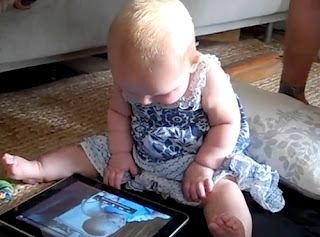
My studies in Ed/Psych have forever ruined YouTube videos as entertainment. I can rarely just watch one and laugh; I now find I must analyze it. Here is a clip of a baby with a magazine that I plan to show my undergrads. When I try to tell them that technology changes the way children think, they just nod and then pretend to ignore their phone. When we watch this baby try to move the pictures on a magazine cover the way she uses the tablet computer, then my words take on a new meaning.
As the video states, the technology in her world has wired her to perform a particular action in order to learn. This baby expects that when she brushes her fingers over something she will see a change; she understands that this is an action that will bring on learning because she can manipulate it and because it brings something new to her senses.
For most of us, when we were children, the equivalent action was to turn a page. Think of babies sitting contentedly with a cardboard book, patiently learning how to use finger and thumb to manipulate the page. Turning the page meant something new to learn. Just as uplifted arms mean seeking of comfort.
The things we encounter in our environment have a significant effect in directing our learning. If we spend the day outside with nature, we learn differently than if we spend the day inside on the couch. A small change early on, sets the direction of learning. This is one reason why the American Association of Pediatrics does not recommend media or screen (TV, computer, game) activities for young children. It is not so much as what they are doing, as what they are NOT doing, that makes the difference.
What we do on a daily basis influences and creates who we are. Let's put that in a more practical way: reading God's word on a daily basis influences and creates who we are.
Not only that, but in this way, the God who made us continually creates who we are. Reading, praying over, and reflecting on God's word, whether on a tablet computer or with the old fashioned hard copy, will make changes and bring learning. God's word is an app with guarantee:
"For as the rain and the snow come down from heaven and do not return there but water the earth, making it bring forth and sprout, giving seed to the sower and bread to the eater, so shall My Word be that goes out from My mouth; it shall not return to Me empty, but it shall accomplish that which I purpose, and shall succeed in the thing for which I sent it. "For you shall go out in joy and be led forth in peace; the mountains and the hills before you shall break forth into singing, and all the trees of the field shall clap their hands. Isaiah 55:10-12 (ESV)
The reason God designed our brains to learn this way was so that we could continually adapt to our environment. A baby's brain, from before birth, is already preparing for communication. We know this because babies are born recognizing their mother's voice over other sounds. Likewise, the baby's brain begins to establish patterns for learning. Parents and siblings, as a source of information, become a guiding pattern. So does page turning, or more recently, screen flipping.
Adult brains work the same way. When God leads us to seek wisdom in His word, the action of reading makes changes in our brain that lead us back to that source of learning. God's word will not return to Him void. He set the stage for that learning from the beginning of our existence.
even the darkness is not dark to you; the night is bright as the day, for darkness is as light with you. For you formed my inward parts; you knitted me together in my mother's womb. I praise you, for I am fearfully and wonderfully made. Wonderful are your works; my soul knows it very well. Psalm 139:12-14 (ESV)
God has hardwired your operating system to seek His word and to learn from His teaching. You are His creation and He loves you.
Abba Father, Amen.
Tuesday, November 1, 2011
Know

I love this clip of the twin boys at nap time. As soon as I saw it I knew it would have to go into my lectures for my Ed Psych class, but I couldn't decide where.
Do I include it in moral development because climbing out of the crib did not warrant an "uh-oh" until mom walked into the room?
Do I include it in modeling because one twin learns enactively and the other vicariously?
Do I include it in problem solving noting that the brave twin re-thinks and finds a way to keep his actions secret?
I finally settled on motivation because one twin sees naptime as his fate and the other refuses the inevitable. My question to the class will be: "Which twin would you rather have in class, the one who is obedient, or the one who can think outside the crib?
I will let the students mull over that one for a while.
It is interesting how the twins understood the camera meant they were being watched. Of course, they don't realize, yet, that mom has other ways of knowing what is happening in the nap room. They might still be at the stage where they think if they cover their own eyes no one can see them. They certainly don't like to be watched.
O God, You know my folly; the wrongs I have done are not hidden from You. Psalm 69:5
My mother-in-law does not like to be watched, either. Her current cognitive abilities make it wise that she be checked-in on from time to time. I see her when I set up her meds, my daughter stops in when she goes to the studio to work and now the in-home aide assigned to clean her house needs to check on hygiene and eating habits. Understandably, Dorris expresses frustration with this series of events. Still, we do it, because we know it is what is best for her. Even though she doesn't like it, she probably understands that it is better than the alternative which requires moving to a place that can maintain constant supervision.
From when we are babies, until we are elderly, we require some level of supervision, for play, for work, for life skills. We don't generally like it; we usually accept it.
You know when I sit down and when I rise; You discern my thoughts from afar. Psalm 139:2
The Bible has 887 verses that include the word "know." Both reminders of what God knows about us and what He chooses to let us know about Him. The Bible contains everything we can know about God, this side of heaven. Even if we read it continuously, we will still only know an infinitesimal amount. And we can't know that without God making it possible.
God, however, knows everything about us. Because we grow up in a world that values "privacy" and because we know we have a lot to hide, this causes us much consternation. We want to move the camera, and hide our words, thoughts and actions from a God who is perfect.
It is better, I think, to contemplate the up-side to an omniscient God. He knows our faults; this is true. But, He also knows our sorrows, our joys and our needs. We may not like nap time, but it sure is nice to have someone who knows we would like some milk and a cookie when we wake up.
My God knows me and loves me in spite of that. My God knows me and provides for me before I even know I need it. My God knows me and knows His plans for me. My God knows me and died and rose again to take a way my sins, even before I was born.
Our God knows.
Be still, and know that I am God. Psalm 46:10
Thursday, September 22, 2011
Ian has

I had my phone off because I was in a meeting. When I turned it back on, it buzzed letting me know what texts were waiting. I scrolled down the list until I saw the title of one that made me catch my breath.
Ian has
I didn't want to open the text and finish the sentence. I knew there had been an MRI to check on the reason for back pain. I knew there had been two previous devastating MRI results, one six years, and another three years ago. I did not want to see the reality that this fine young man was facing his enemy for the third time in his short life. I didn't want to finish the sentence "Ian has ______" as if not opening that text would somehow keep it from being true.
But, it is true. Ian has cancer, again. This is the third time he has heard this news, the third time he has had to rearrange his life, the third time he has had to face treatment and the uncertainty it brings.
Yes, Ian has cancer, but he has so much more. We can finish that sentence with better words that are just as true.
Peace I leave with you: My peace I give you. I do not give to you as the world gives. Do not let your hearts be troubled and do not be afraid. John 14:27
Last Sunday, Ian stood up in front of the congregation and thanked us for our prayers. He took time to reassure us that he had peace about the diagnosis and treatment. This young man, barely a teenager, has the courage and presence of mind to share his peace with those of us who pray and grieve over him. God has blessed him with a peace we cannot even imagine and in that peace we see evidence of the gift of his faith.
Therefore, since we are surrounded by such a great cloud of witnesses, let us throw off everything that hinders and the sin that so easily entangles. And let us run with perseverance the race marked out for us, fixing our eyes on Jesus, the pioneer and perfecter of faith. For the joy set before him he endured the cross, scorning its shame, and sat down at the right hand of the throne of God. Consider him who endured such opposition from sinners, so that you will not grow weary and lose heart. Hebrews 12:1-3
Ian has a huge cloud of witnesses surrounding him in this race. We pray for him, cry over him, cheer him on, and stand ready to help in any other way that is needed. Because of his premature birth, Ian has literally grown up in the midst of this cloud of people who love him and pray for him. He feels this every day in a tangible way. His courage in this race gives us evidence of the gift of our faith.
Ian has the promise of eternal life.
For God so loved the world that he gave his one and only Son, that whoever believes in him shall not perish but have eternal life. John 3:16
In the light of Ian's challenge this verse takes on a whole new significance. He will not perish; he has eternal life. We pray the next 80 years or so of that eternal life are spent here on earth, but we know that he has eternal life, none-the-less.
Abba, Father, Please, send your hand of healing to your child, Ian, even as You bless him with peace, strength and faith. Amen, amen, amen.
Wednesday, August 17, 2011
Dependence day
The classes I am taking this semester are up on my on-line Blackboard page. This means I can take an early peek at the syllabus, assignments and textbooks.
Excuse me while I breathe in this paper bag for a minute . . . . . easy. . . . .calm down . . . .
I have already decided to drop one of the three classes I registered for because the first two have an enormous workload: 4 class discussions to lead, 5 papers, 73 readings and one large project. All I know about the third class is that it has 3 required textbooks and about 10 recommended. That is more than enough reason to save that class for another semester.
This time in the semester is not a good time for me. I know too much about what will be expected of me, but I have little reminder of the good parts of going to school. By next week I will still feel overwhelmed, but I will also have touched base with several people with whom I have developed a strong friendship. In seeing them, again, God will remind me that He has a plan on how to get me through this semester.
In the reading I did this summer, I came across an interesting idea. Much of Developmental Psychology of the last 100 years, or so, has centered on the idea that when we are born we bond, or attach, to our parents and spend the rest of our childhood going from complete dependence to independence. The point being made in the book was that the field is starting to realize the reverse may also be true. In other words, we are born, bond with our parents and that is the first step in learning how to work with, and depend on, others. In fact, the more we study learning, the more we realize that social skills, such as empathy, are a key component to good learning.
Becoming independent is not a theme in scripture; at least not a theme with a good ending. If we work toward independence we work ourselves away from God. Here is a good example:
For I solemnly warned your fathers when I brought them up out of the land of Egypt, warning them persistently, even to this day, saying, Obey my voice. Yet they did not obey or incline their ear, but everyone walked in the stubbornness of his evil heart. Therefore I brought upon them all the words of this covenant, which I commanded them to do, but they did not." Jeremiah 11: 7-8 (ESV)
In our sin we want to be independent, but the effect is similar to a two-year-old insisting "me do it." We simply cannot do anything on our own. We are completely dependent on God.
So Jesus said to the Jews who had believed in him, "If you abide in my word, you are truly my disciples, and you will know the truth, and the truth will set you free." They answered him, "We are offspring of Abraham and have never been enslaved to anyone. How is it that you say, 'You will become free'?"
Jesus answered them, "Truly, truly, I say to you, everyone who commits sin is a slave to sin. The slave does not remain in the house forever; the son remains forever. So if the Son sets you free, you will be free indeed. John 8: 31-36 (ESV)
I am looking at this verse in a new way. I need to be enslaved (dependent on) to God in order to experience freedom (independence). So for now, I will go to God in prayer, begin my reading assignments, and meet with two good UNL friends for a picnic lunch, tomorrow. God's promise to love and care for me will filter into my brain and heart as I read and pray over His word.
Remember your word to your servant,
in which you have made me hope.
This is my comfort in my affliction,
that your promise gives me life. Psalm 119:49-50
Thank you, God, for new adventures (even scary ones), thank you for friends and thank you for complete and utter dependence on You.