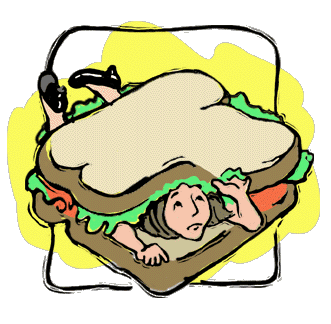
Most
of us in the “Sandwich Generation” are between parents and children. My husband
and I are sandwiched between two moms. Dorris has fallen nine times since
January. My mother has fallen twice in that time; on the second occasion, she
broke her arm. So far, this is the year of falling.
Dorris
has learned to relinquish control. This was not easy for her as she was the
directing force in Paul’s family. She organized, she prepared, she took care of
details. Because of this, the family ran smoothly. She also used this gift in
her many hours of community service. As she aged, and her dementia progressed,
she had to learn how to give up control.
This relinquishment started with the car keys. It was not easy. It took
a drive through the front door of a restaurant and several conversations with
her children and her doctor, but eventually she relinquished control over that
part of her life. Throughout the progression of her illness she has been a
coping model for how to let go of control and accept trust.
My
mother’s situation is very different. She is mentally ill and when under
stress, her view of the world is twisted and torn. She is currently at a rehab
facility to receive physical and occupational therapy. Earlier this week I arranged
to take her out to lunch. When I came back the next day to pick her up I found
a very different person. She had been told that she needed to stay a few days
longer than she hoped. This caused her stress and anger which when mixed with
her bipolar illness and break through the threshold of her medication. She accused the facility of giving her a
faulty bed, which did not allow her to sit properly. She was certain that she
alone was mistreated and that everyone was working together to make her life miserable.
She directed her anger at me when I asked questions for clarification because
this meant that I was on “their” side. She was so angry that she would shake
her head in her balled-up fists when she talked making it impossible to hear
her. This from someone who, 24 hours earlier, had no complaints about her care.
I
tried several techniques that I have learned from my life of living with her
illness. I tried to calm her down with a soft, reassuring voice, to no avail. Simply
listening and accepting her distorted view did not ease her anger. Even asking
her if she still wanted to go to lunch sent her in a tizzy because I “should
have known” her answer. A change of environment did not distract her and when I
tried to talk about a different subject, she simply redirected her anger. At
the point at which she started talking to herself, I knew our lunch was done. I
returned her to the facility and let the nurse know I suspected she had moved
into a manic state.
When
I was a young child I used to accept blame for my mother’s anger outbursts –
even if they didn’t make sense. When I
became a young adult, I was able to realize that most people have emotions that
come as a result of action or events. For my mother, she has an emotion and
then looks for a reason to attach it to. She sometimes wakes up angry and
because she does not recognize her anger as part of her illness, she convinces
herself that people are against her. She also is unable to see that her view of
reality is wrong. Even physical evidence does not dissuade her.
My sister and brother also came to this
realization and it is what helps us to survive these incidences. Often we are
left with no choice but to walk away.
The
most difficult thing about these episodes is that when my mother leaves the
manic state, while her anger will have dissipated, her “explanations” will
not. By next week, she will no longer be
angry with me, but she will still be convinced that I was working with the
people at the facility to make her life miserable. Over the years, she has lost
all trust in me and my siblings because of what she believes about us from her manic states.
This
lack of trust makes it nearly impossible to help her. She is at risk of losing
her home health services because she does not trust her doctor, her physical
therapist, the nurse, the safety inspector checking her apartment, or her
children desperately trying to create a safe place for her to return to. She
does not like what we are doing and that is no surprise. It is difficult to
give up that kind of control to allow others to keep you safe. But, in my
mother’s case, when she looks at her world through the twisted view of her
manic state, she is convinced that she must be right and, therefore, the only explanation is that everyone else is out
to harm her.
Dorris’
Alzheimers also distorts her sense of reality. She calls us several times a
week certain she is at a zoo, at a restaurant, at a hotel, at a library, even a
bowling alley. Her brain is certain it has figured out the situation and even
when we point out the fact that her “hotel” room has her own furniture, she
still does not quite believe us.
But,
she trusts us and that makes all the difference.
Because
of trust, she will calm down. Because of trust, she will obey when I encourage
her to grab her walker and walk down to the dining room for dinner. Because of
trust, she is able to find ways to survive her always-new environment. She
never argues with me when I assure her that there is no reason to travel to
Blackburn Mo., as her parents are not waiting for her. Even though her brain tells
her otherwise, she trusts, and moves on.
Her
life is better, her life is safer, her life makes better sense, because of
trust. And because of this trust, it is possible for others to help her.
Because
of sin, my brain is in a constant state of distortion. The fruit from the
tree in the Garden of Eden, removed my ability to rest in perfect trust.
Because of that sin, I erroneously think I know better than God does. Because
of that sin, I have to twist things around in order to explain why they happen.
Because of that sin, I fool myself into thinking I know what is best, that I
know what to ask for, or that the world needs me to make the “right” thing happen.
I
have replaced trust with manipulation, and that makes all the difference.
We
cannot know the real picture. The only way we can survive the world we have fashioned
– a world of sinners and sin – is to trust in the Creator instead of the ones
who created the mess.
Yet,
we are certain that we know better:
If
I could do this . . .
If
only he would . . .
When
I finish . . .
Yes,
but. . .
No,
way will I . . .
I’ll
give her a piece of my mind . . .
Why
doesn’t God . . . ?
In
our efforts to be good stewards, to follow God’s Law, to share His love, we
still think we can direct the world. Sin makes us think we need control. Our sin
makes perfect trust impossible.
When
cleaning my mother’s apartment, my brother and my son moved a dresser.
Underneath I found a card and when I picked it up I realized it was written in
German. I soon realized that it was my
mother’s baptismal certificate. A
beautiful reminder from my Heavenly Father that God loves my mother, not
because of her actions, but because He is her Father and she is His child.
God
loves us no matter what.
He
loves us even when we complain and try to take control:
And the whole congregation of the people of Israel grumbled
against Moses and Aaron in the wilderness, and the people of Israel said to them, “Would
that we had died by the hand of the Lord in the land
of Egypt, when we sat by the meat pots and ate bread to the full, for you have
brought us out into this wilderness to kill this whole assembly with hunger.”
(Exodus 16: 2-3, ESV)
He loves us even when we think we know better:
“Woe to him who strives with him who formed him, a pot among earthen pots! Does the clay say to him who forms it, ‘What are you making?’
or ‘Your work has no
handles’? (Isaiah 45: 9, ESV)
He loves us even before we come to Him:
Blessed be the Lord! For he has heard the voice of my pleas for mercy. The Lord is my strength and my shield; in him my
heart trusts, and I am helped; my heart exults, and with my song I give thanks to him. (Psalm 28: 6-7, ESV)
He
loves us when we are finally ready to relinquish some control:
But I trust in you, O Lord; I say, “You are my God.” My times are in
your hand; rescue me from the hand of my enemies and
from my persecutors! Make your face shine on your
servant; save me in your steadfast love! (Psalm 31:
14-16, ESV)
He reminds us that our best example of trust comes
from children without the knowledge and experience to think they know better:
O
Lord, my heart is not lifted up; my eyes are not
raised too high; I do not occupy myself with things
too great and too marvelous for me. But
I have calmed and quieted my soul, like a weaned child
with its mother; like a weaned child is my soul within
me. O Israel, hope in the Lord from this time forth and forevermore. (Psalm 131, ESV)
He loves us,
no matter what. He loves us with a perfect love. We trust Him with an imperfect
trust.
At this
point I must make my confession. Circumstances in my life have greatly
interfered with my imperfect trust. I need God's forgiveness and your prayers to remind me
that God has a plan for me to navigate responsibilities and requirements. I
need to relinquish control, to humble myself, to obey.
Thank you
for your care and for your prayers. And praise be to God for the blessing of unconditional love.
Humble yourselves, therefore, under the
mighty hand of God so that at the proper time he may exalt you, casting all your anxieties on him, because he
cares for you. (I Peter 5: 6-7, ESV)