Thursday, April 9, 2015

Salt of the Earth


“You are the salt of the earth, but if salt has lost its taste, how shall its saltiness be restored? It is no longer good for anything except to be thrown out and trampled under people's feet.
“You are the light of the world. A city set on a hill cannot be hidden. Nor do people light a lamp and put it under a basket, but on a stand, and it gives light to all in the house. In the same way, let your light shine before others, so that they may see your good works and give glory to your Father who is in heaven. 
(Matthew 5: 13-16, ESV)

Our world recently lost someone who was the essence of the phrase "salt of the earth." My dictionary of clichés describes this phrase as applying to an individual "considered to be the best or noblest of his kind." This definition fits Gil better than any other person I have known, both in its secular and Christian sense.

I first met Gil when I began teaching at the same Lutheran Church where his daughter was the music director. The church had just started a school, and the devil was working overtime to close this ministry. It was open season on the teaching staff.

It seemed to me that everything I did was criticized, and I was certainly not alone. People who had never been to our classrooms were accusing us of being bad teachers. People who had never taught before were certain they knew what we should be doing differently. There were false accusations and constant denigration that interfered with teaching and learning. I wondered why I was teaching, at all. 

Some days, when I brought the children outside for recess, I would see Gil’s familiar face. He donated much of his time and talent to the church each week. If I was on the playground and he was finishing a job, he would come over and visit. We would talk about all sorts of things – stories about kids, about the early days of our church (he was a charter member), and stories about people. In this gentle way, he gave me some joy and bolstered my faith in God’s ability to bring good out of His sinful people and the situations we create. 

In this way, Gil was not just being the salt of the earth. He was salt and light. He was shining a light on God’s goodness and helping me to understand that goodness and to preserve it. He continues to influence me as his life reminds me also to go and be salt and light in this same gentle way.

I know when I stop and ask a church worker how things are going -  I know that when I feel the urge to ask, again, and wait for an answer, that I am blessed to use my God-given faith in a way that was modeled by Gil.

I know that when I look for something positive to say or do, in a negative situation, that I am blessed to use my God-given faith in a way that was modeled by Gil.

I know that when God shows me the joy of talking with people who are not in the spotlight, who are feeling lonely, who are feeling depressed, that I am using my God-given faith in a way that was modeled by Gil.

A good friend recently spoke to my Adolescent Development class about the work she does with at risk youth. She talked about the need each young person has for five people in their life who would do nearly anything for them, five people who care about them, who influence them to help them see that their world can be better. I believe this is true for all of us. Gil was definitely one of my "five." In simple, consistent ways, he showed me he cared and he showed me a better way of living my faith.

I am blessed to know him; he will be sorely missed. I thank God for Gil's faith, his gentleness, his service, and that I could know him for almost a third of his 91 years. God is good.

My new favorite thing about Gil will be to look for him in his children, grandchildren, and great-grandchildren. God is good, all the time.

His master said to him, ‘Well done, good and faithful servant. You have been faithful over a little; I will set you over much. Enter into the joy of your master.’ (Matthew 25:21, ESV)

Friday, April 3, 2015

Finding familiarity


Paul received a message from the hospice nurse that Dorris was agitated. His text asked me to go over and see her after class.


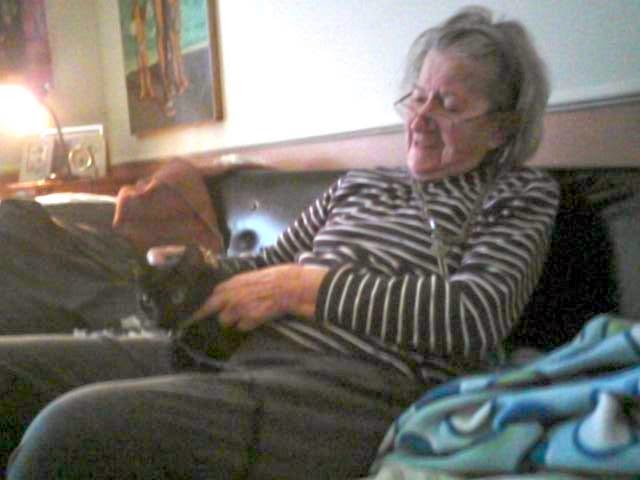
I decided to bring one of our cats for a “cat therapy” visit. In an unusual demonstration of empathy, Natalia settled down into Dorris' lap and purred her enjoyment of the scratches and petting. Dorris settled in quite nicely, too.


I began to dig through her closet to find some clothes to wear for her trip to our house for Easter. I found a jacket and asked her if she would like to wear it.


“Yes,” she said, “it has a bit of magnificence about it.”


It is interesting to me how quickly the Dorris I know and love can seemingly leave and then return. In the thirty years I have known her, until her Alzheimer’s, Dorris never, ever gave the impression that she was lost, or somehow not in control of all that was happening around her. I loved that constant assurance.


She is now at the stage where nothing is familiar for more than a few seconds at a time. When I visit with the cat, I must tell her over and over, that the cat does not live in this room, that the cat came to visit Dorris – not the other way around. I must constantly answer her question with the assurance that this room is where she lives and that it is not my house.


Today, I responded to the familiar questions by asking her if she recognized the furniture, pictures, and sculpture in the room.


“Well, they do look familiar -  like I have seen them somewhere before.”


Imagine living in a world where things looked vaguely familiar, but not like home. Then, imagine rediscovering this about every 10-15 seconds. 


It is little wonder that she gets agitated. It is more of a wonder why she isn’t agitated all of the time.


But a nine-pound cat can make all the difference. A cat doesn’t have to be familiar. It doesn’t have to belong. Once it snuggles in and starts purring, that is enough familiarity to keep anyone happy.


Thank you, God, for pets.


On the days leading up to Good Friday, Jesus tried to warn the disciples that change was in the works. His behavior must have been unfamiliar to his followers. Jesus raged in the temple, rode a donkey, washed feet, and allowed His capture.


Jesus’ death meant that, even though, the world was full of familiar things – nothing was, or ever would be, the same again. 


In this the love of God was made manifest among us, that God sent his only Son into the world, so that we might live through him. In this is love, not that we have loved God but that he loved us and sent his Son to be the propitiation for our sins. 
(I John 4: 9-10, ESV)


The fact that our sin could only be appeased by the death and resurrection of God’s Son should be a source of constant agitation, and guilt, and humiliation. Instead, Jesus took these emotions as a burden along with our sins.


Our sin prevents us from making heaven a familiar home. 


God’s love creates the home where we will live, forever, in His most familiar love and care.


By this we know that we abide in him and he in us, because he has given us of his Spirit. And we have seen and testify that the Father has sent his Son to be the Savior of the world. 
(I John 4: 13-14, ESV)


Sunday, January 18, 2015

Life


I drove Dorris home after church today. We took the usual route, and she asked the usual questions about where we were and where she lived.

Dorris: Why don’t I recognize where we are? Did I hit my head?

Kim: No, you did not hit your head. You have Alzheimer’s.

Dorris: I don’t like that word “Alzheimer’s.” It is often bandied about and used where it doesn’t belong. Now I guess I will have to accept that it belongs to me.

We were unusually quiet the rest of the drive.

Dementia is cruel. It leaves its victim in a constant state of anxious confusion. Thankfully, my mother-in-law, is comfortable with asking important questions over and over, again. I answer them as if I have never heard them before because I know that this will reduce her anxiety if even just for a moment. Sometimes she will inform me that she will probably ask me the same question more times before she’s done. I always reassure her that repeating a question is just fine as long as it is a question I can answer. We laugh and I make her promise not to ask me about string theory, which inevitably makes her ask “what is string theory?”

Dementia takes away memories; it takes away the comfort of knowing where you are, where you are going, and who is taking you there. Dementia takes so much, but it often leaves behind the realization that the disease is present. Dorris doesn’t remember that she cannot balance when she walks, but she remembers what Alzheimer’s is and what it means for her future.

I gave a children’s message at church today on the topic of life. We discussed several pictures to determine which was “alive” and which was “not alive.” We agreed about the snowman,

 
but there was some discussion about the picture of Olaf.


I showed them a picture of a baby in the womb.

 
We talked about how babies get food before they are born and then had to stop ourselves from lifting up our shirts and dresses to see our belly buttons.

I shared the sad news that some people do not see the baby in the womb as being “alive.” Science tells us that this baby has life, but many do not count this life as having value.

What about Dorris’ life? Does her life have value? In some countries, she could be euthanized at her request. Physician aided death is legal in five states here in the U.S. In Belgium, it is legal to end the life of a terminally ill child. That is, so long as the parents show they are capable of making a good decision regarding the life of their child.

Yes, the world is full of pain and misery and we want to see this pain end. How is death a good decision?

If it is acceptable to end the life of an unwanted unborn child, how long will it be until we use the same rationalization to end the life of a born child? Or, the life of a severely injured adult? Or, the life of someone in emotional pain and misery? When will we start to feel comfortable ending the life of people like Dorris who can no longer remember or make sense of their world?

This is the verse we read for the children’s message: 

And this is the promise that he made to us—eternal life. (I John 2:25, ESV)

God loves life. He loves the life of a newborn baby. He loves the life of an elderly person lost in her memories. He loves the life of a terminally ill child, parent, or sibling. He loves a long healthy life. He loves a long life of pain and misery, because He loves those who suffer. He loves the joyful and He loves the dejected and depressed.

God does not want misery for His children. He wants life.

He grants us eternal life through the saving work of His Son, and through the faith given us by the Spirit. We will live forever with Him in heaven.

But, eternal life goes both ways. God loved us before we were born. From before the beginning of Earthly time, God knew us, and loved us.


Wednesday, November 26, 2014

Masks

This picture is a link for ordering the book
Click on this picture to order the book.
Terry Buethe is a Lutheran pastor, counselor, teacher, writer and good friend. He wrote this book to offer encouragement to those who suffer from depression and for those who feel sad or discouraged from personal life events. It is an excellent book for personal devotions or for group work. 

He has graciously given me permission to post one of the readings from the book. 

Enjoy, be encouraged, know you are loved by your Heavenly Father. 


Re-Learning to Receive

“Tis’ better to give than to receive,” is one of those ageless adages we have all heard. Most would agree it’s not bad advice, especially when trying to teach our children to be generous, compassionate people. But as with many other rules about life, it is not an absolute standard. Circumstances in our lives can send us through cycles of being givers and then being receivers over and over again.

Unfortunately, some of us have learned to be givers so well, it’s hard to become a receiver. When we are giving, we are in control of the situation. We might feel a certain sense of pride or accomplishment that we are able to help someone else.

But to be placed in a situation where we need someone else to help us upsets our sensibilities. We feel as though we have lost ground. We don’t like being dependent on anyone else. We feel vulnerable at the mercy of another person’s decisions. We might even wonder what receiving from this person is going to cost us in the long run because we have also learned “there’s no such thing as a free lunch.” And if we are willing to be honest with ourselves, our pride also gets in the way. We don’t want to admit to anyone, not even to ourselves, that we can’t handle everything life throws at us on our own.

Of course, that’s a ridiculous stance to take. No one is equipped to handle everything in life. And if we stop to think about it, it becomes really obvious. We regularly rely on mechanics, doctors, plumbers and truck drivers to provide us with services or deliver goods that we need. We are all dependent on each other, no matter how much we want to believe we are not. But that “I can do this myself” voice is strong and it can prevent us from letting others know we are in need of something they can provide. It can also prevent them from intervening when we aren’t even aware we need help.

Our heavenly Father knows all about our prideful independent streak. He knows we need an example of how it should be done and even to do it for us. That is one of the reasons He sent His Son in human flesh to experience the trials and temptations we do, to feel the hunger, the thirst, the pain and even the fear that we do. We have a Lord and Savior who knows exactly what we are going through and He showed us how to receive as well as how to give.

Jesus received help from the angels after His forty days in the wilderness where Satan repeatedly tempted Him. He and His disciples received meals and lodging from people in many of the places they traveled. He received from a woman who washed His feet with her tears. He showed us there is nothing shameful in receiving.  There is nothing demeaning in allowing another person to come alongside us when we are overwhelmed. In fact, as He was describing the Judgment, He said that when we receive assistance from another person, it allows that person to minister to Jesus. (Matt 25:31-46)

God almost always works through people. He rarely performs big showy miracles. Instead He uses the hands and tongues and feet and ears of those who follow Him. He comes to you through the people who care about you and offer to help. And He comes to you through His Word with promises to care for you in all situations.

Suggested readings: Hebrews 4:14-16

© 2014 Terry Buethe